
Pool Leak Detection Miami, FL
If you’re topping off your pool more often than you used to, or the water line keeps dropping faster than you’d expect, you’re right to wonder whether it’s a leak. In Miami’s heat, some water loss is normal. A leak is different, and it can sit in the pool shell, a fitting, the equipment or the underground plumbing. Leak Detection Miami FL helps Miami-Dade pool owners and property managers connect with independent local providers who handle pool leak detection Miami property owners need.
Pool leak detection Miami testing is the process of confirming whether a pool is losing more water than evaporation explains, and then narrowing down where the water is escaping. Knowing the source first means repairs can be planned around the actual problem.
Leak Detection Miami FL is a leak detection referral service. When you contact us, we connect you with an independent, local provider who performs the inspection.
What Are the Signs of a Pool Leak?
The most common sign of a pool leak is a water level that drops faster than normal evaporation would explain, especially when it keeps dropping at a similar rate day after day. Other signs include wet or soft ground near the pool, water around the equipment, and cracks or loose tiles.
Pool leak detection Miami at a glance: Miami heat and wind can take a lot of water through evaporation, so the first step is to confirm the loss is more than normal. Pool leak detection Miami providers then check the shell, skimmer, returns, main drain, lights and equipment pad with dye and pressure tests. Accurate pool leak detection Miami testing points to the exact fitting or line. If you drain and refill after a repair, Miami-Dade Water and Sewer offers a once-a-year pool (sewer) credit for eligible accounts.
None of these signs confirms a leak on its own. Wet ground can come from irrigation or rain, cracks can be cosmetic, and water loss can come from splashing, backwashing or heavy use. Together, though, they’re worth a closer look.
The water level drops faster than expected.
You’re adding water more often than in previous seasons, or the level falls noticeably overnight.
The auto-fill runs constantly.
If your pool has an automatic fill, you may not see the level drop at all, but the fill may run often and you may see a water bill that keeps climbing.
Wet or soft ground around the pool.
Damp areas, soggy grass or sinking pavers near the pool or along the path of the plumbing. If the wet area is between the meter and the house, see underground water line leak detection.
Water around the equipment pad.
Puddles, drips or mineral buildup around the pump, filter, heater, valves or plumbing connections.
Cracks, gaps or loose tiles.
Cracks in the pool surface, separated tiles at the waterline, or gaps between the pool and the deck.
Air in the system or circulation problems.
Bubbles at the returns, a pump that loses prime, or changes in pressure can point to a suction-side problem.
Chemistry that’s hard to keep balanced.
Frequently adding fresh water dilutes chemicals, which can make the pool harder to keep balanced.
Is My Pool Leaking or Just Evaporating?
Every pool loses some water to evaporation, so a dropping water level doesn’t automatically mean a leak. The question is whether the pool is losing more water than evaporation alone would explain under the current conditions.
How much a pool evaporates changes from day to day. It depends on:
- Temperature, both of the air and the water. Heated pools can evaporate more.
- Sunlight, especially for pools in full sun.
- Wind, which carries moisture away from the surface.
- Humidity, since drier air pulls more water from the pool.
- Use, including swimmers, splashing, water features and spillovers.
Because these factors vary so much, there’s no single “normal” number that applies to every pool. A better approach is to compare your pool’s water loss with a container of pool water sitting in the same conditions. That’s the idea behind the bucket test.
How Do I Do a Bucket Test on My Pool?
A bucket test compares how much water evaporates from a bucket with how much the pool loses over the same period. Because the bucket and the pool sit in similar conditions, a pool that drops noticeably more than the bucket may be losing water to something other than evaporation.
- STEP 1
Prepare the pool.
Bring the pool to its normal water level, and turn off the automatic fill if you have one.
- STEP 2
Fill a bucket with pool water.
Fill it to within a few inches of the top.
- STEP 3
Set the bucket on a pool step,
so it sits partly in the pool water and stays at a similar temperature. Make sure it’s stable.
- STEP 4
Mark both water levels.
Mark the water level inside the bucket, and mark the pool’s water level on the outside of the bucket or on the tile.
- STEP 5
Wait about 24 hours.
Run the pump on its normal schedule, and avoid swimming or adding water.
- STEP 6
Compare the drops.
If the pool level dropped noticeably more than the water in the bucket, a leak is possible.
Optional: repeating the test with the pump off can give the provider extra information, since some leaks change depending on whether the circulation system is running.
What are the limits of the bucket test?
The bucket test gives an indication. It isn’t a diagnosis. Results can be thrown off by:
- Rain, which adds water to both, but not always equally
- Swimmers, splashing or water features during the test
- Backwashing the filter or an auto-fill that wasn’t fully turned off
- A bucket that tips, sits in different sun or wind, or isn’t filled correctly
- Very small leaks that are hard to see in a single day
If the result is unclear, or you’re adding a lot of water regularly, professional pool leak testing is the more reliable next step.
Please don’t drain your pool to look for a leak. In areas where groundwater sits close to the surface, which is common in parts of Miami-Dade, an empty pool can be pushed upward by groundwater pressure and damaged. Leave any draining decisions to a qualified pool professional.
Where Do Pool Leaks Usually Occur?
Pool leaks usually occur in one of four areas: the pool structure itself, the fittings built into it, the equipment, or the underground plumbing that connects them. Each one has different clues and needs a different kind of testing.
The pool shell and surface
- Cracks in plaster, concrete or tile
- Tears or separated seams in vinyl liners
- Cracks in fiberglass pools
- Gaps where the tile line or coping meets the pool
- Steps, benches and spa spillovers
Fittings and penetrations
- Skimmers, especially where the skimmer meets the pool wall
- Return fittings, where filtered water comes back into the pool
- The main drain at the bottom of the pool
- Pool lights and light niches, including the conduit that carries the wiring
- Other fittings for cleaners, jets or water features
Pool equipment
- Pump seals and lids
- Filters and their valves
- Heaters and heat pumps
- Valves, unions and plumbing connections at the equipment pad
- The automatic fill valve and its line
Underground plumbing
- Suction lines that carry water from the skimmers and drains to the pump
- Return lines that carry water back to the pool
- Lines to spas, waterfalls or other features
Safety note: don’t open pool light niches, electrical boxes or equipment wiring yourself. Pool lights and equipment combine water and electricity, so leave those areas to qualified professionals.
How Does Pool Leak Detection Miami Testing Work?
Professional pool leak detection Miami testing works by confirming that the pool is losing more water than evaporation explains, narrowing the loss to the structure, the equipment or the plumbing, and then testing those areas to find the source. The methods depend on the pool’s construction, its plumbing layout, and where the evidence points. Not every provider uses every method.
- 01
Review the Pool and Its History.
The provider asks how much water you’re adding and how often, about your bucket test results, the pool’s age and type, recent repairs or resurfacing, and any signs you’ve noticed.
- 02
Visual Inspection.
The provider checks the shell, tile line, fittings, light, equipment pad and the area around the pool for cracks, gaps, moisture and wear.
- 03
Dye Testing.
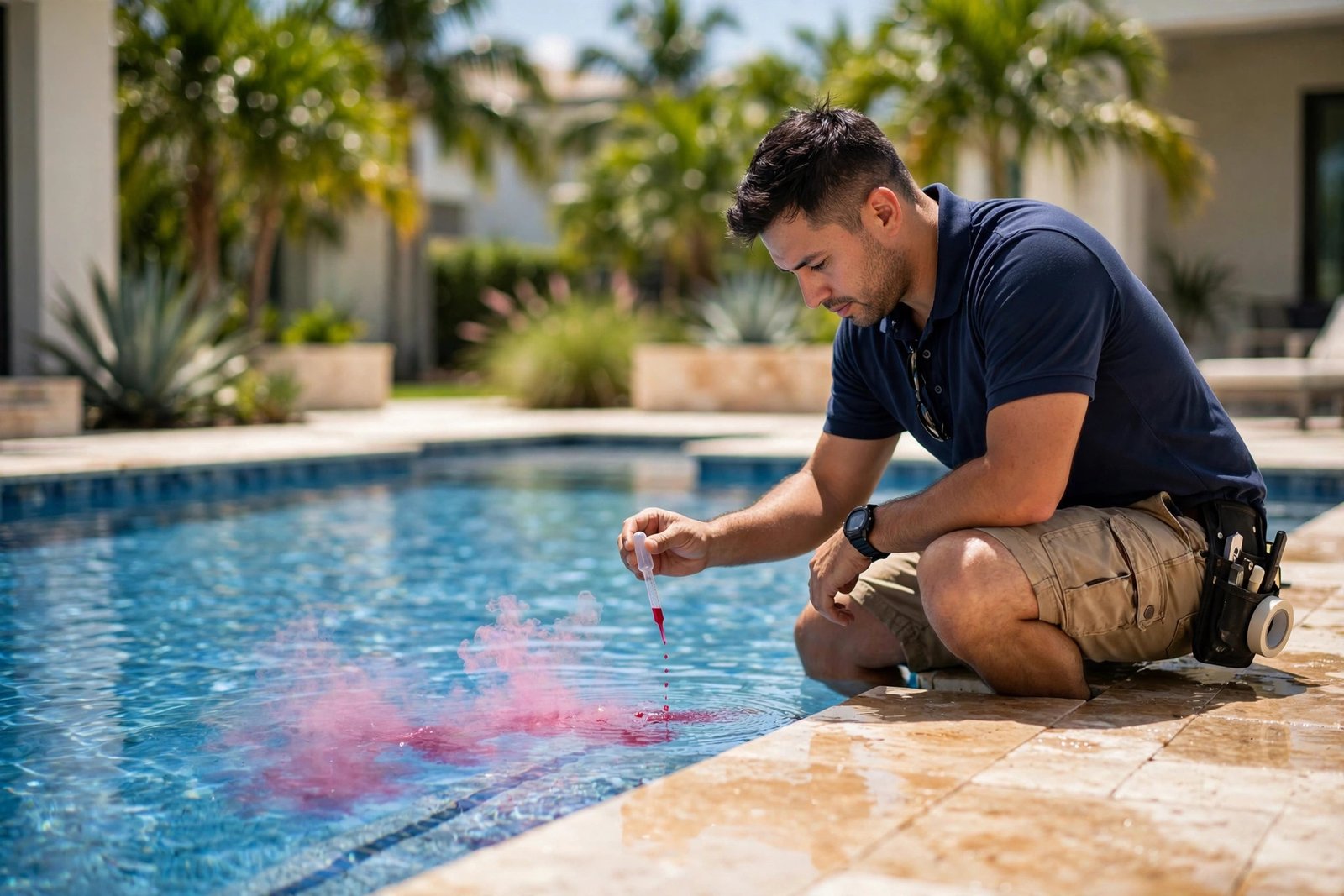
With the water still, a small amount of dye is released near a suspected crack or fitting. If water is escaping there, the dye is pulled toward the opening. Some providers inspect underwater areas directly as part of this step.
- 04
Pressure Testing the Plumbing.
Individual lines can be isolated and pressurized to see whether they hold. This helps show whether an underground suction or return line is leaking.
- 05
Locating Underground Leaks.
If a line fails a pressure test, acoustic equipment or line-locating tools may be used to narrow down where along the line the leak is.
- 06
Explain the Findings.
The provider explains what was tested, where the leak or leaks appear to be, and what they recommend. Ask whether written findings or photos are available.
Why Find the Source Before Repairing a Pool Leak?
Finding the source before repairs prevents money from going to the wrong fix. Resurfacing a pool won’t solve a leaking return line, and replacing a pump seal won’t fix a cracked skimmer. Without testing, it’s easy to repair something that wasn’t the problem.
Accurate location also limits disruption. If an underground line is leaking, knowing where means a smaller excavation through the deck or yard instead of opening long sections looking for it.
It can also help you plan. Once you know the source and how many leaks there are, you can compare repair options, timing and costs with real information.
Locating a leak and repairing it are separate steps. Some pool leak detection Miami providers also offer repairs, while others locate the leak and leave the repair to a pool contractor you choose. Ask before booking.
What Affects Pool Leak Detection Miami Costs?
The cost of pool leak detection depends mainly on the pool’s configuration, where the leak appears to be, and how much testing it takes to find it. A crack in a visible fitting is usually simpler to confirm than a leak somewhere along an underground return line.
Pricing varies by provider. Confirm the cost of detection, and what it includes, directly with the independent provider before work begins.
Detection and repair are priced separately. The detection fee covers finding the leak. Repairs, such as patching a crack, replacing a fitting or excavating an underground line, are a separate cost.
Factors that affect price:
Pool type and configuration.
Concrete, vinyl and fiberglass pools, attached spas, water features and the number of lines all affect scope.
Where the suspected leak is.
Structural, equipment and underground plumbing leaks call for different testing.
Accessibility.
Lines under decks, pavers or landscaping are harder to test and locate.
Methods required.
Dye testing alone may be enough, or the job may need pressure testing and underground locating.
Further investigation.
Multiple leaks, intermittent leaks or unclear results can require additional testing.
What Should I Have Ready Before Requesting Pool Leak Detection Miami Help?
A few details help the provider understand the problem and plan the visit:
- How much water you’re adding and how often, for example inches per week or how often the auto-fill runs
- Your bucket test results, including whether you tested with the pump on, off or both
- Pool type and age: concrete or gunite, vinyl liner or fiberglass, and any attached spa or water features
- Recent work, such as resurfacing, retiling, equipment replacement or plumbing repairs
- Photos of cracks, loose tiles, wet areas or the equipment pad
- Water bills, if your bill has gone up along with the water loss
- Access details, such as gate codes, pets, and where the equipment is located
A note on your water bill: Miami-Dade Water and Sewer Department offers a once-a-year credit related to refilling a pool after it’s drained, with a $12.50 verification fee. Some accounts are excluded. Check the current rules directly with your water utility before relying on it. For high bills caused by hidden leaks, see our Miami-Dade leak adjustment guide.
How Does Leak Detection Miami FL Connect Me With a Provider?
Leak Detection Miami FL is a referral service, not a pool contractor. Here’s how a request works:
- 01
You contact us
by phone or through the request form, and describe what’s happening with your pool.
- 02
We connect you with a provider.
We connect you with an independent local provider who handles pool leak detection in Miami-Dade.
- 03
The provider contacts you directly
to discuss your pool, scheduling and their fees.
- 04
The provider performs the inspection
and explains their findings.
- 05
You decide on next steps,
including who handles any repair.
Where Is Pool Leak Detection Miami Service Available?
Leak Detection Miami FL helps pool owners and property managers find pool leak detection in Miami, Miami Beach, Miami Springs, Miami Lakes, North Miami and Miami Shores.
If your area isn’t listed, contact us to check availability.
Leak Detection in Miami
Serving Miami-Dade County
Pool Leak Detection Miami FAQs
How can I tell if my pool has a leak?
Watch whether the water level drops faster than evaporation would explain, especially at a steady rate day after day. Wet ground near the pool, water around the equipment and an auto-fill that runs constantly are other signs. A bucket test can give an early indication, and professional testing confirms it.
How do I tell pool evaporation from a leak?
Compare your pool’s water loss with a bucket of pool water sitting in the same conditions. If the pool drops noticeably more than the bucket over about a day, a leak is possible. Evaporation varies with heat, sun, wind, humidity and use, so there’s no single normal rate for every pool.
What is the bucket test?
It’s a simple comparison. You place a bucket of pool water on a pool step, mark the water level inside the bucket and the pool level outside it, and compare both after about 24 hours with no swimming or refilling. It gives an indication, not a diagnosis.
Where do pool leaks commonly occur?
Common locations include cracks in the shell or tile line, skimmers, return fittings, the main drain, pool lights, equipment such as pumps, filters and valves, and the underground suction and return lines.
Can an underground pool plumbing leak be detected?
Often, yes. Providers can pressure test individual lines to see which one is leaking, then use acoustic or line-locating equipment to narrow down where. Repairing an underground line usually requires digging at the located spot.
What affects pool leak detection costs?
The pool’s type and configuration, where the leak appears to be, how accessible the plumbing is, the testing methods needed, and whether more investigation is required. Confirm pricing directly with the provider, since detection and repair are priced separately.
Does pool leak detection include the repair?
Not necessarily. Detection finds where the water is escaping. Some providers also offer repairs, and others leave the repair to a pool contractor you choose. Ask before booking.
How can I request a connection with a pool leak detection Miami provider?
Call us or use the request form, and describe what’s happening with your pool. We’ll connect you with an independent local provider in Miami-Dade, who will contact you to discuss the details and scheduling.
Think Your Pool Is Leaking?
If your pool is losing more water than evaporation explains, or your bucket test points to a leak, pool leak detection can help find where the water is going before you spend money on repairs. Contact Leak Detection Miami FL to connect with an independent local provider in Miami-Dade.
Related Leak Detection Resources
Leak Detection Services
Areas We Serve

A Miami-Dade referral service connecting homeowners, condo owners and property managers with independent local leak detection providers.
Call us today(645) 465-5599Call NowServices
Leak Detection Miami FL is a referral service and does not perform inspections or repairs. Services are provided by independent local providers.
© 2026 Leak Detection Miami FL. All rights reserved.